Additional resources
Additional resources
Modelling fission gas behaviour in irradiated nuclear fuel using physics-based multi-scale approaches.
Course description
This MOOC explores the key physical mechanisms governing fission gas production, retention, and release in nuclear fuel rods. Using the open-source SCIANTIX code, participants learn how physics-based multi-scale modelling supports fuel safety assessments and innovation in reactor technologies.
Total workload of the course: 5 hours
This MOOC is provided by Politecnico di Milano.
This MOOC is one of the outputs of the OperaHPC project (WP8, D8.7).


Co-funded by the European Union
OperaHPC is funded by the European Union. Views and opinions expressed are however those of the author(s) only and do not necessarily reflect those of the European Union or European Commission-Euratom. Neither the European Union nor the granting authority can be held responsible for them.
Intended Learning Outcomes
At the end of the course, you will be able to:
- Explain the structure and function of a nuclear fuel rod
ESCO: nuclear physics ESCO: nuclear energy - Identify the physical mechanisms related to fission gas behaviour in irradiated fuel
ESCO: nuclear physics ESCO: nuclear energy - Use a multi-scale and physics-based approach to describe fission gas swelling and release
ESCO: mathematical modelling ESCO: scientific modeling - Perform basic simulations with the SCIANTIX code of nuclear fuel irradiated in stationary or transient conditions
ESCO: computer simulation
Prerequisites
Scientific background knowledge deriving from high school and higher education is required, in particular in the fields of chemistry, physics, and mathematics.
A university-level understanding of materials science is recommended, especially regarding the structure of solids, diffusion phenomena, and microstructural evolution under irradiation.
While advanced programming skills are not required, a basic familiarity with structured input files and simulation workflows will help participants engage effectively with the practical modules.
Finally, participants are expected to possess scientific critical thinking abilities to analyse simulation results and compare them with experimental data.
Activities
Over and above consulting the content, in the form of videos and other web-based resources, you will have the opportunity to discuss course topics and to share ideas with your peers in the Forum of this MOOC. The forum of this MOOC is freely accessible, and participation is not guided; you can use it to compare yourself with other participants, or to discuss course contents with them.
Assessment
Your final grade for the course will be based on the results of your answers to the assessed quizzes. You have an unlimited number of attempts at each quiz, but you must wait 15 minutes before you can try again. You will have successfully completed the course if you score 60% (or higher) in each one of the assessed quizzes. The maximum score possible for each quiz is given at the beginning of the quiz. You can view your score in the quiz on your last attempt or on the 'Grades' page.
Certificate
You can achieve a certificate in the form of an Open Badge for this course, if you reach at least 60% of the total score in each one of the assessed quizzes and fill in the final survey.
Once you have completed the required tasks, you will be able to access ‘Get the Open Badge’ and start issuing the badge. Instructions on how to access the badge will be sent to your e-mail address.
The Badge does not confer any academic credit, grade or degree.
Information about fees and access to materials
The course is delivered in online mode and is available free of charge.
Course faculty
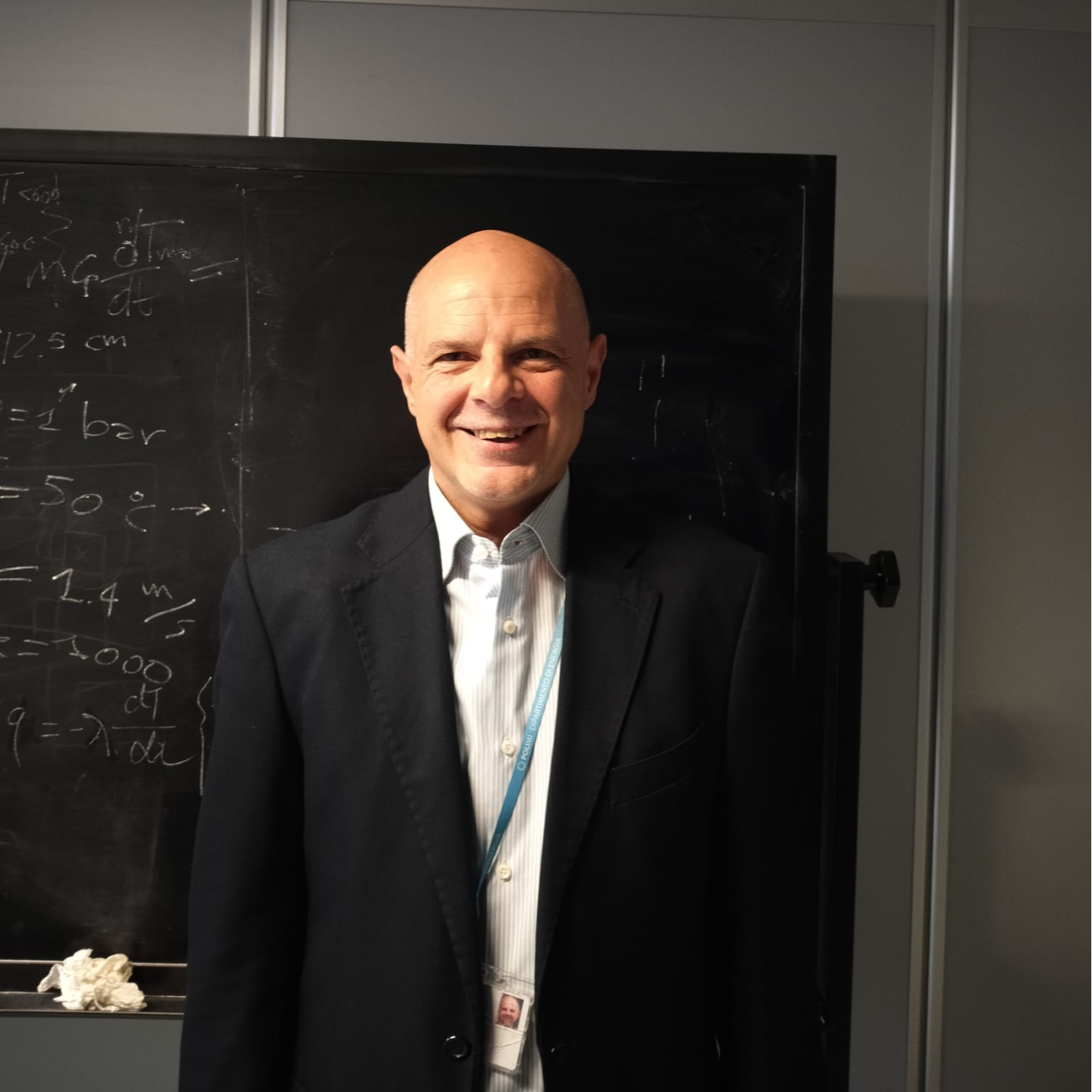
Lelio Luzzi
Teacher
Lelio Luzzi is associate professor of Nuclear Power Plants at Politecnico di Milano (POLIMI), where he teaches Nuclear Design and Technology for the MSc in Nuclear Engineering. He graduated in Nuclear Engineering (Laurea) and completed his Ph.D. in Science and Technology in Nuclear Plants at POLIMI. He has been visiting scientist at the Materials Research Unit of JRC-Karlsruhe and at the Science and Technology Department of Westinghouse Electric Company. Since 1999, his research is focused on two main areas: i) development, modelling and characterization of structural components and nuclear fuels (including liquid fuels), supported by thermal-fluid-mechanical analyses and fuel performance code simulations; ii) development of innovative modelling approaches and simulation tools for the analysis of components and nuclear reactors of new generation (LMFRs, MSRs, LWRs, SMRs). Lelio Luzzi has been the Principal Investigator of numerous competitive projects (EURATOM H2020 and Horizon Europe), as well as of relevant research projects with important companies (Westinghouse) and national/international institutions (IAEA, OECD-NEA, JRC-European Commission, DOE-US, IRSN-France, CEA-France, KIT-Germany, TU-Delft) in the nuclear energy sector, especially for what concerns the nuclear fuel performance. Lelio Luzzi co-authored more than 210 peer-reviewed publications (including 2 books with an international editor and 12 contributions to books), 60 technical reports, and 1 European patent.

Davide Pizzocri
Teacher
Davide Pizzocri is a researcher at Politecnico di Milano, where he teaches Advanced Topics in Nuclear Engineering, and gives lectures in the courses of Nuclear Design and Technology and Introduction to Nuclear Engineering. He graduated in Nuclear Engineering and completed his Ph.D. in Energy and Nuclear Science and Technology in 2018. His research focuses on nuclear fuel behaviour, fission gas behaviour, and multi-scale modelling and simulation of nuclear materials. He is among the main developers of the SCIANTIX code, and is active in the field of open source scientific tools in the nuclear industry. Davide Pizzocri is currently involved in several international research initiatives (H2020, Horizon Europe projects, CONNECT-NM partnership) and didactic activities (lecturer and organizer of schools, e.g. European School on Nuclear Material Science). He authored 60+ journal publications, and 100+ contributions technical deliverables and contributions to international conferences.
Giovanni Zullo
Teacher
Giovanni Zullo holds a degree in Nuclear Engineering from Politecnico di Milano, where he earned his Ph.D. in Energy and Nuclear Science and Technology in 2024. His doctoral research focused on the development and assessment of meso-scale simulation codes for modelling the behaviour of gaseous and volatile fission products in irradiated nuclear fuel. He is currently a research assistant in the Nuclear Reactor Group at the Department of Energy, Politecnico di Milano. His research activities focus on the development, verification and validation of thermo-mechanical fuel performance codes, and the modelling of fission gas and volatile fission product behaviour in irradiated nuclear fuel for both conventional and advanced reactors. He is involved in multi-scale computational modelling and contributes to international research projects aimed at enhancing fuel performance and safety in next-generation nuclear systems.

Elisa Cappellari
Teacher
Elisa Cappellari holds a degree in Nuclear Engineering from Politecnico di Milano, where she is currently pursuing a Ph.D. in Energy and Nuclear Science and Technology. Her research focuses on the behaviour of fission products in irradiated nuclear fuel, with particular emphasis on development of physics-based models at the grain scale. She has actively contributed to the development of the open-source code SCIANTIX, both during her master’s thesis and Ph.D., working on its extension to account for chemically reactive fission products through the integration of thermochemistry modules. As part of her MSc thesis, she collaborated with the European Commission Joint Research Centre (JRC) in Karlsruhe, investigating fission gas release mechanisms from micro-cracks in nuclear fuel. This work was developed within the framework of OPERAHPC, contributing to the improvement of predictive simulations by enhancing the understanding and modelling of the thermomechanical behaviour of UO2-based fuel under irradiation.
Acknowledgements
The use of microscope photographs published in:
INTERNATIONAL ATOMIC ENERGY AGENCY, Post-irradiation Examination and In-pile Measurement Techniques for Water Reactor Fuels, IAEA TECDOC (CD-ROM) No. 1635, IAEA, Vienna (2010).
International Atomic Energy Agency, T. WISS, V.V. RONDINELLA, R.J.M. KONINGS, D. STAICU, D. PAPAIOANNOU, S. BREMIER, P. POLM, O. BENES, J.-Y COLLE, I. HOLT, P. VAN UFFELEN, “Properties of the high burnup structure in lwr”, High Burnup Fuel: Implications and Operational Experience, Proceedings of a Technical Meeting Held in Buenos Aires, 26–29 November 2013, IAEA TECDOC (CD-ROM) No. 1798, IAEA, Vienna (2016) 34–51
International Atomic Energy Agency, J. NOIROT, C. GONNIER, L. DESGRANGES, Y. PONTILLON, J. LAMONTAGNE, et al., “Lwr fuel gas characterization at cea cadarache leca-star hot laboratory”, Post-irradiation Examination and In-pile Measurement Techniques for Water Reactor Fuels, IAEA TECDOC (CD-ROM) No. 1635, IAEA, Vienna (2010) 129–144.
and featured in the MOOC videos has been granted by INTERNATIONAL ATOMIC ENERGY AGENCY that retains the copyright.
Contact details
If you have any enquiries about the course or if you need technical assistance please contact pok@polimi.it. For further information, see FAQ page.