Additional resources
Additional resources
The role of spaces in teaching: a key element in instructional design for both in-person and online learning.
This course is part of
Course description
This MOOC is part of the Smart Learning Design series, which began with the first online course “Smart Learning Design: A visual method for designing effective in-person and online learning experiences.” (SLD101). It is aimed at university and school teachers, trainers, and decision-makers in educational institutions, with the goal of providing logical and methodological tools for effectively integrating and enhancing digital resources and technologies in classroom teaching.
How are learning spaces evolving?
How can classroom activities be integrated with online ones?
How can we manage our spaces to meet the challenges of future changes?
Throughout this course, we explore which technical and technological resources are available, which learning scenarios should be considered, and which key variables must be integrated in order to make forward-looking decisions—building on the framework introduced in the SLD101 MOOC.
Total workload of the course: 12-15 hours
This MOOC is provided by Politecnico di Milano.
For a wider diffusion of the course, learning materials including texts, infographics, diagrams and videos were translated from Italian to English through Artificial Intelligence software. Therefore they may contain inaccuracies.
This MOOC was produced as part of the Edvance project – Digital Education Hub per la Cultura Digitale Avanzata. The project is funded by the European Union – Next Generation EU, Component 1, Investment 3.4 “Didattica e competenze universitarie avanzate".






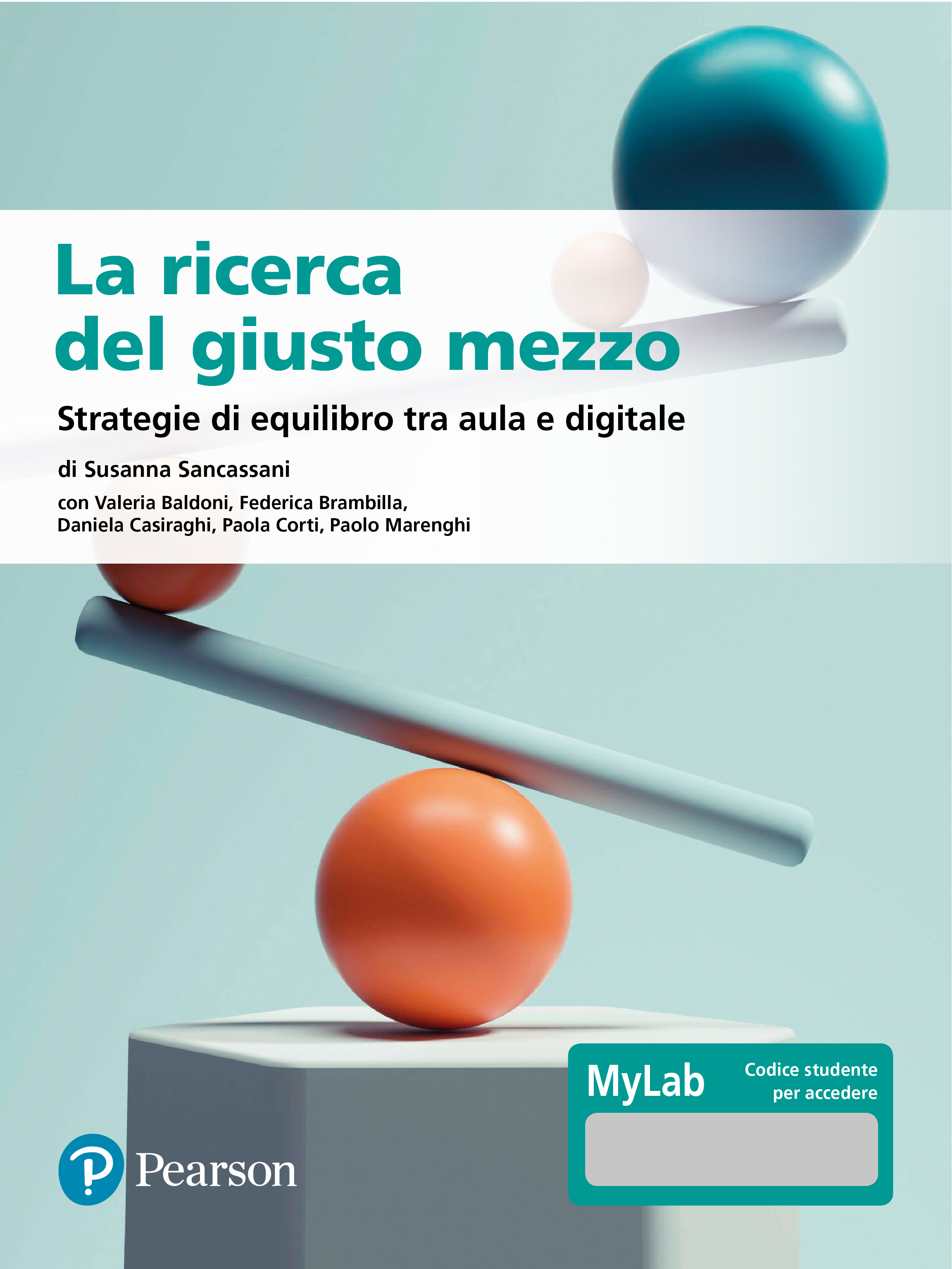

This MOOC is closely integrated with the book “La ricerca del giusto mezzo - Strategie di equilibrio tra aula e digitale” (2023) by Susanna Sancassani with Valeria Baldoni, Federica Brambilla, Daniela Casiraghi, Paola Corti, and Paolo Marenghi, published by Pearson, Milan. All visual materials used in the course are drawn from this publication.
Intended Learning Outcomes
If you actively participate in this course, you will be able to:
- Understand the fundamental principles behind the design of a learning space: flexibility, reconfigurability, innovative use of technology, creativity, personalization, and adaptability.
ESCO: developing educational programmes ESCO: pedagogy ESCO: information and communication technologies (icts) - Recognize the importance of effectively integrating technology into classrooms to enhance the learning experience in both physical and online environments.
ESCO: instructional design models ESCO: conduct educational activities ESCO: use IT tools - Describe and use learning spaces for different types of activities. Consider flexibility in reconfiguring classrooms for various teaching contexts, including both traditional, lecture-style settings and collaborative ones.
ESCO: use learning strategies ESCO: use IT tools
Prerequisites
No formal knowledge is required.
Activities
Over and above consulting the content, in the form of videos and other web-based resources, you will have the opportunity to discuss course topics and to share ideas with your peers in the Forum of this MOOC. The forum of this MOOC is freely accessible, and participation is not guided; you can use it to compare yourself with other participants, or to discuss course contents with them.
Assessment
Your final grade for the course will be based on the results of your answers to the assessed quizzes. You have an unlimited number of attempts at each quiz, but you must wait 15 minutes before you can try again. You will have successfully completed the course if you score 60% (or higher) in each one of the assessed quizzes. The maximum score possible for each quiz is given at the beginning of the quiz. You can view your score in the quiz on your last attempt or on the 'Grades' page.
Certificate
You can achieve a certificate in the form of an Open Badge for this course, if you reach at least 60% of the total score in each one of the assessed quizzes and fill in the final survey.
Once you have completed the required tasks, you will be able to access ‘Get the Open Badge’ and start issuing the badge. Instructions on how to access the badge will be sent to your e-mail address.
The Badge does not confer any academic credit, grade or degree.
Information about fees and access to materials
The course is delivered in online mode and is available free of charge.
Course faculty

Paolo Marenghi
Teacher
He coordinates the activities of the technical areas supporting METID’s projects. His work focuses in particular on spaces and technologies that support teaching and learning processes.
Course credits
Camera, set design, editing, video schemes and motion graphics: Daniele Albricci, Mauro Landriscina, Amedeo Longeri, Luca Tantimonaco.
Graphics and diagrams: Valeria Baldoni.
System and community management: Davide Mezzera, Lia Navarotto, Giosuè Suriano.
Contact details
If you have any enquiries about the course or if you need technical assistance please contact pok@polimi.it. For further information, see FAQ page.